Nasal vaccine combats bird flu infection in rodents (Links to an external site)

Researchers at WashU Medicine have developed a nasal vaccine against the highly pathogenic H5N1 avian influenza virus, or bird flu, which has jumped from wild birds to livestock to humans. When tested in rodents, the vaccine elicited a strong immune response and prevented infections in animals exposed to H5N1.

Since it was first detected in the U.S. in 2014, H5N1 avian influenza, commonly known as bird flu, has jumped from wild birds to farm animals and then to people, causing more than 70 human cases in the U.S. since 2022, including two fatalities. The virus continues to circulate among animals, giving it the opportunity […]

Immunotherapy reduces plaque in arteries of mice (Links to an external site)

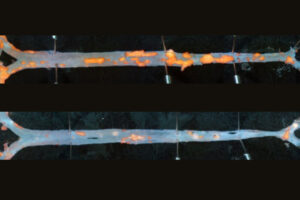
An immunotherapy reduces plaque in the arteries of mice, offering a potential new strategy to treat cardiovascular disease, according to a study led by WashU Medicine researchers. An artery from an untreated mouse (top) shows more plaque (orange) than that of a mouse treated with the antibody-based immunotherapy (bottom).

Scientists have designed an immunotherapy that reduces plaque in the arteries of mice, presenting a possible new treatment strategy against heart disease. The antibody-based therapy could complement traditional methods of managing coronary artery disease that focus on lowering cholesterol through diet or medications such as statins, according to the findings of a new study led […]

Breath carries clues to gut microbiome health (Links to an external site)

WashU Medicine and Children’s Hospital of Philadelphia researchers found that an analysis of compounds exhaled in breath can be used to infer which microbes are living in the gut, paving the way for a rapid, non-invasive breath test to monitor and diagnose gut health issues.

The human gut is home to trillions of beneficial microbes that play a crucial role in health. Disruptions in this delicate community of bacteria and viruses — called the gut microbiome — have been linked to obesity, asthma and cancer, among other illnesses. 

WashU startups attract record-setting $1.7 billion in private-sector investment over past year (Links to an external site)

St. Louis-based biotech company Wugen, which is developing cell-based immunotherapies for hard-to-treat blood cancers, is among the WashU startups that collectively have attracted a record-setting total of $1.7 billion in private-sector investment over the past year.

Startup companies built on Washington University in St. Louis discoveries attracted a record $1.7 billion in private-sector investment over the past year, accelerating the commercialization of WashU innovations into life-changing diagnostics, therapeutics and medical devices. Among those innovations are a blood test to diagnose Alzheimer’s disease; immunotherapies to treat aggressive blood cancers; and an AI-based […]

Genetic analysis explains rare disease severity, points to possible treatment (Links to an external site)

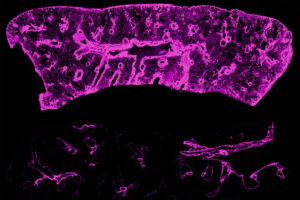
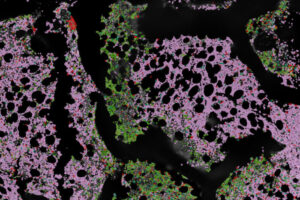
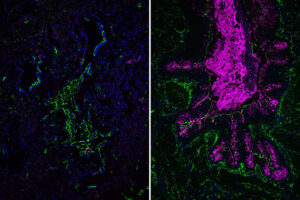
Normal lung tissue is shown on the left. On the right is lung tissue from a person with primary ciliary dyskinesia with a CCDC39 mutation. A large mucus plug is visible in magenta, demonstrating the severe airway problems seen in such patients with these specific mutations. (Image: Brody lab/WashU Medicine)

Researchers at Washington University School of Medicine in St. Louis have uncovered why some patients with a rare genetic disorder called primary ciliary dyskinesia have worse lung problems than others with the same disorder. The discovery, published in Science Translational Medicine, suggests that gene therapy to restore a missing protein complex could help treat the […]

Prabhu Coauthors ACC Scientific Statement on inflammation and cardiovascular disease (Links to an external site)

Sumanth Prabu, MD, Lewin Distinguished Professor of Cardiovascular Diseases and Chief of the WashU Cardiovascular Division

Sumanth Prabu, MD, Lewin Distinguished Professor of Cardiovascular Diseases and Chief of the WashU Cardiovascular Division, co-authored the 2025 scientific statement published by the American College of Cardiology on the role of inflammation in cardiovascular disease. The new statement reviews residual inflammatory risk, screening & management, and new anti-inflammatory strategies.

Getting Ready for a Heart Failure Polypill, Well Before the Data Are In (Links to an external site)

Justin Chen, MD

A new paper in JACC: Advances delves into the factors that may affect implementation of a polypill for heart failure with reduced ejection fraction (HFrEF)—assuming one proves safe and effective—and outlines strategies for an eventual rollout. This exercise “just reinforces the idea, in addition to previous data showing therapeutic inertia and reluctance to use other […]

Hospitalists Contribute to Diabetic Ketoacidosis Protocol Improvements (Links to an external site)
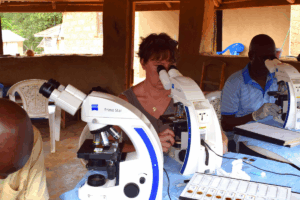
Margo Girardi, MD, SFHM, and Gina LaRossa, MD

Margo Girardi, MD, SFHM, and Gina LaRossa, MD, contributed to an abstract and article that were featured in the Society of Hospital Medicine’s Journal of Hospital Medicine. The article, titled “Putting SQuID on the menu: A subcutaneous insulin protocol for diabetic ketoacidosis,” demonstrates how using a subcutaneous insulin protocol on hospitalist units for low-to-moderate severity DKA […]

Barriers Remain to Widespread Use of Polypills for CVD Therapy in High-Income Nations As Testing Continues (Links to an external site)

Anubha Agarwal, MD, MSc

The World Health Organization (WHO) added cardiovascular polypills to its 2023 Model List of Essential Medicines, and research continues to show that these medications are effective at preventing atherosclerotic cardiovascular disease (ACD) among various other forms of cardiovascular disease. Yet experts say obstacles remain to the adoption of these medications in high-income developed nations.

Meet the Researcher: Kameron Bradley (Links to an external site)
Kameron Bradley

A new preprint by Kameron Bradley of the Jeffrey Millman Lab, titled “Divergent Cell-Type Specific Hypoxia Responses in Human Stem Cell–Derived and Primary Islets,” sheds light on how different types of insulin-producing cells respond to oxygen deprivation, which is a common challenge in cell transplantation therapies for type 1 diabetes (T1D).

Leveraging AI to improve NF1 patient care: Comparing clinical entity extraction methods (Links to an external site)

Figure illustrating the general project workflow.

A new study published in the Journal of the American Medical Informatics Association (JAMIA) showcases how modern AI methods are advancing clinical and translational research in Neurofibromatosis type 1 (NF1). Conducted by Levi Kaster, BS, Ethan Hillis, MS, Inez Y. Oh, PhD, Elizabeth C. Cordell, MD, Randi E. Foraker, PhD, MA, Albert M. Lai, PhD, Stephanie M. Morris, […]

Innovative approach helps new mothers get hepatitis C treatment (Links to an external site)
Giving postpartum mothers with hepatitis C the opportunity to start antiviral treatment while still in the hospital after giving birth — and delivering the medication to their bedside before discharge — significantly increases their odds of being cured, according to a new study at WashU Medicine. (Image: Sara Moser/WashU Medicine)

Hepatitis C, a bloodborne virus that damages the liver, can cause cirrhosis, liver cancer, liver failure and death if left untreated. Despite the availability of highly effective treatments, the prevalence of hepatitis C infection remains high, particularly among women of childbearing age, who account for more than one-fifth of chronic hepatitis C infections globally. Within […]

Microbiome instability linked to poor growth in kids (Links to an external site)

Researchers at WashU Medicine found a link between an unstable, fluctuating gut microbiome and poor growth in children in a study that sequenced the genomic material from fecal samples collected over nearly a year from eight toddlers in Malawi. (Image: Getty Images)

Malnutrition is a leading cause of death in children under age 5, and nearly 150 million children globally under this age have stunted growth from lack of nutrition. Although an inadequate diet is a major contributor, researchers at Washington University School of Medicine in St. Louis found over a decade ago that dysfunctional communities of gut […]

Urano brings expertise to national coverage of wolfram syndrome and its diabetes effects  (Links to an external site)

Fumihiko Urano, MD

On August 4, The Washington Post published an article titled “She was fit and healthy. Why did she get diabetes?” featuring the expertise of Fumihiko Urano, MD, PhD. Dr. Urano is a Professor of Medicine and of Pathology and Immunology with WashU Medicine’s Division of Endocrinology, Metabolism and Lipid Research, and Director of the Wolfram Syndrome International Registry and […]

Genetic study suggests ways to catch blood cancer earlier (Links to an external site)
Kelly Bolton Illustration

A new WashU Medicine study shows that acquired mutations in blood stem cells — whether arising from smoking, exposure to toxins or even normal aging — interact with mutations passed down by parents in important ways that influence a person’s lifetime risk of developing blood cancer. The knowledge could inform early detection and prevention.

Non-canonical functions of DNMT3A in hematopoietic stem cells regulate telomerase activity and genome integrity (Links to an external site)

Luis F. Z. Batista, PhD, Associate Professor and Andrew L. Young, MD, PhD, Assistant Professor, WashU Medicine Division of Hematology

Grant Challen, PhD, Professor, WashU Medicine Division of Oncology, teamed up with  Luis F. Z. Batista, PhD, Associate Professor and Andrew L. Young, MD, PhD, Assistant Professor, WashU Medicine Division of Hematology, on a new research publication “Non-canonical functions of DNMT3A in hematopoietic stem cells regulate telomerase activity and genome integrity”, published this month in […]

Prabhu Lab publishes research on spleen-heart immune link crucial to heart attack recovery (Links to an external site)

Sumanth Prabu, MD, Lewin Distinguished Professor of Cardiovascular Diseases and Chief of the WashU Cardiovascular Division

Researchers at WashU Medicine’s Center for Cardiovascular Research have discovered that specialized immune cells from the spleen play a critical role in healing the heart after a heart attack. The study, led by Sumanth Prabhu, MD, Division Chief and director of the Prabhu Lab, identifies a unique population of macrophages—immune cells that clean up cellular debris—that travel […]

Anne Mobley Butler, PhD, MS, reveals antibiotics in first trimester may raise risk of birth defects (Links to an external site)
Anne Butler Mobley, PhD

Anne Mobley Butler, PhD, MS, Associate Professor of Medicine in the Division of Infectious Diseases at WashU Medicine, was senior author of a study published in JAMA Network Open about the incidence of serious perinatal outcomes when treated for a urinary tract infection (UTI) during pregnancy . Co-authors include Michael Durkin, MD, MPH, Associate Professor of Medicine in […]

Study proposes novel drug to target arterial thrombosis (Links to an external site)

3d rendered medically accurate illustration of the human blood cells and lymphocytes

Researchers at the WashU Medicine  Sah Lab in the Center for Cardiovascular Research and their collaborators have published findings that provide a proof of concept for a  novel drug class to treat myocardial infarction and stroke. Rajan Sah, MD, PhD, a professor of medicine in the cardiovascular division, worked with multiple teams that collaborated to observe and describe a […]

Study proposes novel drug to target arterial thrombosis (Links to an external site)
3d rendered medically accurate illustration of the human blood cells and lymphocytes

Researchers at the WashU Medicine  Sah Lab in the Center for Cardiovascular Research and their collaborators have published findings that provide a proof of concept for a  novel drug class to treat myocardial infarction and stroke. Rajan Sah, MD, PhD, a professor of medicine in the cardiovascular division, worked with multiple teams that collaborated to observe and describe a […]

Catheter and Surgical Ablation for Atrial Fibrillation: A Systematic Review and Meta-analysis

Bryce Montane, MD and Brian Gage, MD, MSc

Bryce E. Montané, MD, Assistant Professor and Brian F. Gage, MD,MSc, Professor of Medicine, WashU Medicine Division of General Medicine and Geriatrics, led an interdisciplinary team to review trials of ablation of atrial fibrillation.  They found that compared with medical therapy, catheter ablation reduced the relative risk for ischemic stroke by 37%, for death by […]

Strategy to prevent age-related macular degeneration identified (Links to an external site)
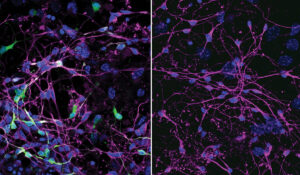
Fixing problems with cholesterol metabolism might help slow or prevent a common cause of age-related vision loss, a new WashU Medicine study in mice has shown. Pictured are color-stained retinal epithelial cells from a mouse eye, the first cells to die as age-related macular degeneration progresses.

A new study from Washington University School of Medicine in St. Louis identifies a possible way to slow or block progression of age-related macular degeneration, a leading cause of blindness in people over age 50. The WashU Medicine researchers and their international collaborators implicated problems with cholesterol metabolism in this type of vision loss, perhaps […]

Environmental hygiene intervention burden in hospital sinks: a prospective study

Kwon

The effects of a prospective sink environmental hygiene intervention on Pseudomonas aeruginosa and Stenotrophomonas maltophilia burden in hospital sinks Jennie Kwon, DO, MSCI, Associate Professor of Medicine at WashU Medicine’s Division of Infectious Diseases, co-published research in eBioMedicine about the burden of hygiene in hospital sinks. Co-principal investigators are; Gautam Dantas, PhD, Conan Professor of Laboratory and Genomic Medicine, and […]

STEP-HI Study Publishes in JAMA Open

""

Study Finds That Testosterone Gel Use in Women Recovering from Hip Fracture Does Not Improve Outcomes Compared to Supervised Exercise Alone Results from a recent multi-center, randomized, controlled trial demonstrate that testosterone gel does not improve physical function compared to exercise alone in older women recovering from a hip fracture. The STEP-HI study was published […]

Bourey defines barriers in sleep medicine and weight management (Links to an external site)
Raymond Bourey, MD

On October 4, the American Academy of Sleep Medicine published an article titled “How weight loss medications are changing the sleep field,” featuring an interview with  Raymond E. Bourey, MD, FAASM. Dr. Bourey has board certification, 25 years in sleep medicine, and is an Associate Professor of Medicine with WashU Medicine’s Division of Endocrinology, Metabolism and Lipid Research. 

Diwan Lab Publishes Cover Story in Journal of Clinical Investigation (Links to an external site)
Dr. Abhinav Diwan, Professor of Medicine

Faculty and other members of the Diwan Lab, including Professor of Medicine and Chief of Cardiology at the St. Louis VA Hospital Abhinav Diwan, MD, have published a new paper titled “Phosphorylation of CRYAB induces a condensatopathy to worsen post–myocardial infarction left ventricular remodeling”. The work was chosen for the cover feature of the latest issue of the Journal […]