Falk Catalyst Awards support pioneering stem-cell discovery and neuromodulation approaches to improve patient lives.
WashU Medicine is proud to celebrate two distinguished faculty members — Jeffrey R. Millman, PhD, and Jin-Moo Lee, MD, PhD — as recipients of the Dr. Ralph & Marian Falk Medical Research Trust Catalyst Award. This competitive award supports bold, early-stage research that has the potential to transform patient care. The Trust is managed by Health Resources in Action (HRiA), a nonprofit organization that oversees funding decisions on behalf of the Trust.
Advancing Insights into Pancreatic Biology
Jeffrey R. Millman, PhD, Professor of Medicine, Division of Endocrinology, Metabolism & Lipid Research, will use Catalyst funding to explore the fundamental biology that drives human pancreatic cell development and function. His lab leverages human pluripotent stem cells to generate pancreatic cell types in vitro — a unique platform that enables the study of early developmental processes not directly observable in humans.
By integrating stem-cell differentiation approaches with advanced cellular and genomic analysis, this project seeks to uncover new principles of pancreas formation and identify key factors that influence cell stability, maturation, and performance within engineered tissues. The insights gained will open new avenues for both basic discovery and translational research in diabetes.
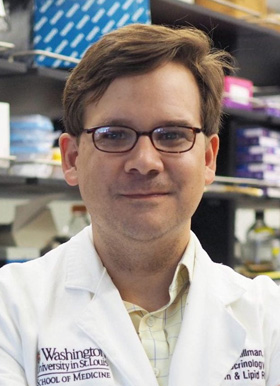
“It’s truly an honor to be selected for the Falk Catalyst Award. This support allows my lab to take creative scientific risks and investigate approaches that could reshape how we understand and treat diabetes. I’m grateful for the trust placed in our work and excited for what this will enable in the coming years.”
Driving Innovation in Acute Stroke Treatment
Jin-Moo Lee, MD, PhD, head of the WashU Medicine Department of Neurology, and Eric Leuthardt, MD, MBA, vice chair of innovation in the Department of Neurosurgery, will use the secured funding to continue their work on a project that aims to reduce brain inflammation and injury after large vessel occlusion (LVO) stroke using vagus nerve stimulation. Lee is the neurologist-in-chief at Barnes-Jewish Hospital and is an internationally renowned expert in stroke and vascular neurology. Leuthardt serves as chief of the Division of Neurotechnology in the Taylor Family Department of Neurosurgery at WashU Medicine and has an extensive background in translational neuromodulation technologies.
Titled “Neuromodulation Using Vagus Nerve Stimulation Following Ischemic Stroke as Therapeutic Adjunct (NUVISTA) 2,” the study plans to enroll 65 acute stroke patients with LVO to undergo vagus nerve stimulation using a non-invasive device. The Lee lab will use biomarkers in the blood to determine whether the intervention is able to reduce brain inflammation in LVO stroke patients during the acute recovery stage, with the ultimate goal of reducing the likelihood of long-term disability in those patients.
More details about the NUVISTA 2 study are available on the Department of Neurology website.

“Vagus nerve stimulation devices have already shown promise in the pilot stage of our study and, if proven to be effective, could be used to treat 800,000 stroke patients per year in the U.S. because of how easy they are to use.”
Jin-Moo Lee, MD, PhD
The Catalyst Award program provides support for high-risk, high reward research projects that address significant therapeutic challenges. HRiA carefully selects projects with the potential to create novel pathways for innovative approaches in disease treatment and ultimately lead to cures. Through the program’s seed funding, translational research is effectively facilitated, enabling its implementation into clinical practice in the near term and eventual transition into commercial development. Financial support for these awards is provided by the Dr. Ralph and Marian Falk Medical Research Trust, Bank of America, Private Bank.
Heidi Lim, Scientific Editor, Department of Neurology, contributed to this announcement.