Atkinson awarded Presidential Gold Medal from rheumatology society (Links to an external site)
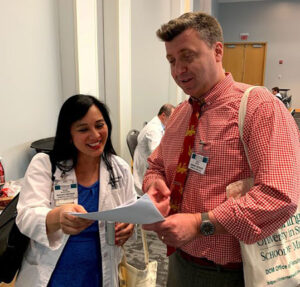
The Department of Medicine’s Office of Faculty Development welcomed new faculty on Wednesday, August 28 with an orientation session followed by an institutional resource fair featuring representatives from a variety of centers, cores and resources within WUSM. Attendees had the opportunity to network with their fellow DOM colleagues while learning more about the many resources […]

OUTmed, an organization for LGBTQIA-identified faculty, staff, trainees and allies at the School of Medicine, participated in St. Louis’ PrideFest and Parade on June 30. OUTmed, a forum based in the Department of Medicine, is open to anyone in the School of Medicine interested in OUTmed activities, regardless of departmental affiliation. This was OUTmed’s third […]
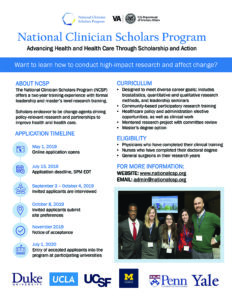
The National Clinician Scholars Program (NCSP) offers a two-year training experience with formal leadership and master’s level research training. Scholars endeavor to be change agents driving policy-relevant research and partnerships to improve health and health care. Download NCSP flyer
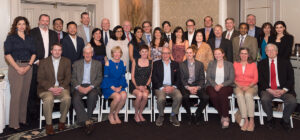
The Department of Medicine recently recognized faculty who have been honored with teaching and clinical awards this past year. Their outstanding contributions fostering medical education and clinical excellence positively influences the medical profession not only locally, but also nationally and internationally.
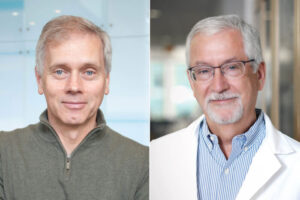
Two physician-scientists at Washington University School of Medicine in St. Louis are among the 100 new members and 25 foreign associates elected to the National Academy of Sciences this year. Election to the academy — which was announced Tuesday, April 30 — is considered one of the highest honors that can be awarded to a […]
Robyn S. Klein, MD, PhD, a physician-scientist recognized internationally for her work on the brain’s immune system, has been named vice provost and associate dean for graduate education for the Division of Biology & Biomedical Sciences (DBBS) at Washington University in St. Louis. She will begin her new post Jan. 1. Read the full story […]
STLpride festival flyer
A new study shows that a type of natural sugar called trehalose triggers an important cellular housekeeping process in immune cells that helps treat atherosclerotic plaque.Read the full story on the School of Medicine’s site »
What if you carried a genetic mutation that left you nearly impervious to heart disease? What if scientists could bottle that and use it to treat everyone else? Read full story »
Eva Aagaard, MD, a noted physician and educator at the University of Colorado School of Medicine, has been named senior associate dean for education at Washington University School of Medicine in St. Louis. Her appointment begins Sept. 1.
Thomas Maddox, MD, is leading the new Health Systems Innovation Laboratory, a partnership between BJC HealthCare and Washington University School of Medicine.
In 1978, during the infancy of the AIDS epidemic, reports about isolated cases of gay men suffering from a rare lung infection and an aggressive cancer began trickling in to the Centers for Disease Control and Prevention (CDC).
A new study co-authored by Mario Castro, MD, suggests a targeted cancer drug called imatinib (Gleevec) may help some patients with severe asthma who do not respond to standard therapy. Read the full story on the School of Medicine’s site »
A new imaging technique based on light and sound produces images doctors can use to distinguish cancerous breast tissue (below the dotted blue line) from normal tissue more quickly than is currently possible. Read the full story on the School of Medicine’s site »
Transplant Center Flyer
John DiPersio, MD, PhD, the Virginia E. and Samuel J. Golman Endowed Professor of Oncology and director of the Division of Oncology has been named a 2017 Legacy Leadership Award honoree by the Gateway Chapter of the Leukemia & Lymphoma Society.
MTS Protocol-Bio-Chemotherapy Dose Rounding_FINAL 2017 (doc) Physician Memo_Chemotherapy-Biotherapy Dose Rounding_2017 (pdf)
Siteman Cancer Center will open its newly expanded and renovated outpatient facility at Barnes-Jewish St. Peters Hospital in St. Charles County on May 1. Read the full story on the School of Medicine’s site »
Jeffrey R. Millman, an assistant professor of medicine in the Division of Endocrinology, Metabolism & Lipid Research at Washington University School of Medicine in St. Louis, has received a 2017 Career Development Award from the Juvenile Diabetes Research Foundation.
Clay Semenkovich, MD, recipient of the 13th Annual Outstanding Faculty Mentor Award from the Washington University Postdoctoral Society.
Patricia Kao, MD, selected as a Carol B. and Jerome T. Loeb Teaching Fellow for 2017-2019.
Sabrina Nuñez, PhD, selected as a Carol B. and Jerome T. Loeb Teaching Fellow for 2017-2019.
Clay Semenkovich, MD, featured as the 57th Annual Max Miller Lecturer in Diabetes Research at the Metabolism Club at the 2017 Combined Meeting of CSCTR and MWAFMR, April 20-21, 2017.
Antibiotic-resistant infection is a rising issue in American society and thousands of people die each year when they develop infections that no antibiotic can control.
Conference organizers invite male speakers over equally qualified women
Michael Diamond, MD, PhD, recognized internationally for his research involving Zika and related viruses, has been named the Herbert S. Gasser Professor of Medicine at Washington University School of Medicine in St. Louis.
Such treatment options are missed by genomic sequencing.