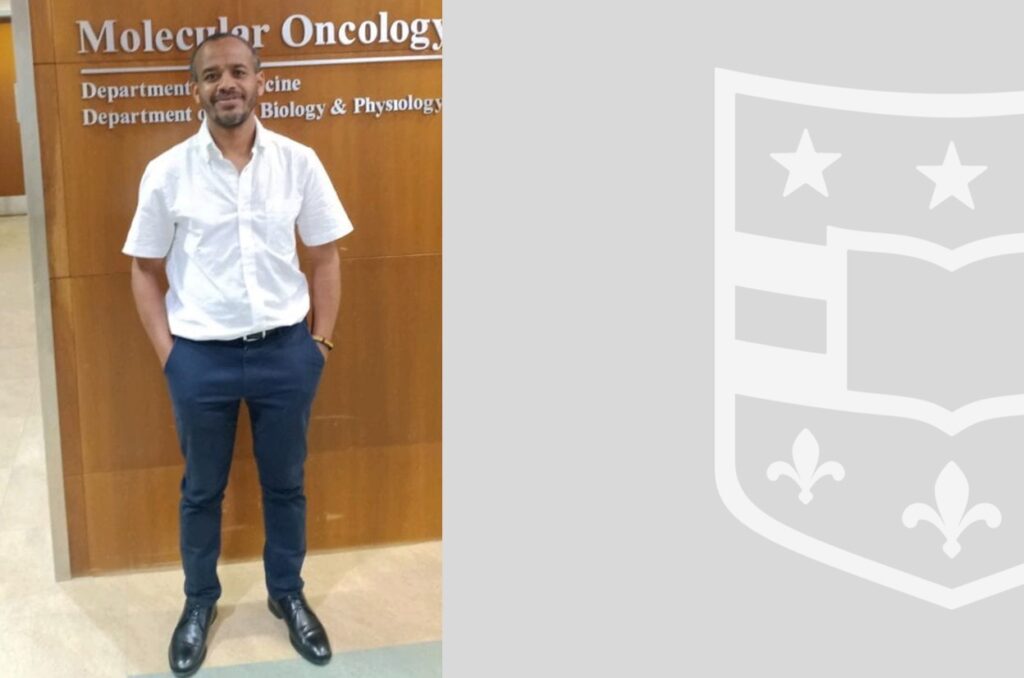
Dr. Ashenafi Bulle joined the Department of Medicine in the Division of Oncology as an Instructor in August 2025. He is a passionate and accomplished biomedical scientist whose career spans veterinary medicine, molecular biology, and translational cancer research across Africa, Europe, and North America. He earned his Doctor of Veterinary Medicine (DVM) with distinction from Addis Ababa University in Ethiopia in 2006, where his early exposure to infectious diseases sparked a lifelong interest in biomedical research. Driven by a commitment to scientific excellence and global impact, he secured competitive international scholarships to pursue advanced training in Belgium, earning an M.Sc. in Molecular Biology (2010) and a Ph.D. in Biomedical Sciences (2019) from Katholieke Universiteit Leuven.
His doctoral research focused on epithelial-to-mesenchymal transition (EMT) in pancreatic ductal adenocarcinoma (PDAC), utilizing both in vitro systems and patient-derived xenograft (PDX) models to explore tumor aggressiveness and therapy resistance. This work resulted in multiple first-author publications and established a strong foundation in cancer biology, tumor-stroma interactions, and translational approaches. Since 2019, Dr. Bulle has been a postdoctoral researcher in Dr. Kian-Huat Lim’s lab at Washington University School of Medicine in St. Louis, where he investigates the molecular basis of adaptive and acquired resistance to KRAS-MAPK pathway inhibitors in PDAC.
His research has contributed to the development of innovative therapeutic combinations, including the pairing of selumetinib with the HER2-targeted antibody-drug conjugate DS-8201a, which showed complete tumor regression in PDAC PDX models and has progressed toward clinical trials. He also played a pivotal role in the preclinical development of other promising combinations involving agents like RMC-6236 and Sacituzumab govitecan, with ongoing studies and manuscripts in preparation for submission to leading journals. Dr. Bulle has presented his findings at major national and international conferences, demonstrating the clinical relevance and translational potential of his work. Beyond the lab, he is deeply committed to education, mentorship, and capacity building.
As a former faculty member and Dean of Student Affairs at Addis Ababa University, he taught molecular biology and introduced laboratory techniques in a resource-limited setting, helping to strengthen the academic foundation for future researchers. In the U.S., he has continued to mentor graduate students and junior researchers while completing formal training in leadership, mentoring, and research ethics. Looking ahead, Dr. Bulle aims to establish an independent research program focused on overcoming therapeutic resistance in PDAC and expanding into the study of tumor–microenvironment interactions. By incorporating advanced technologies such as spatial transcriptomics, single-cell RNA sequencing, and integrative bioinformatics, he seeks to uncover novel, context-specific vulnerabilities that could be exploited for therapy. His unique blend of global perspective, technical expertise, and translational focus positions him to make lasting contributions to cancer research while fostering a diverse, collaborative, and intellectually rigorous training environment for the next generation of scientists.