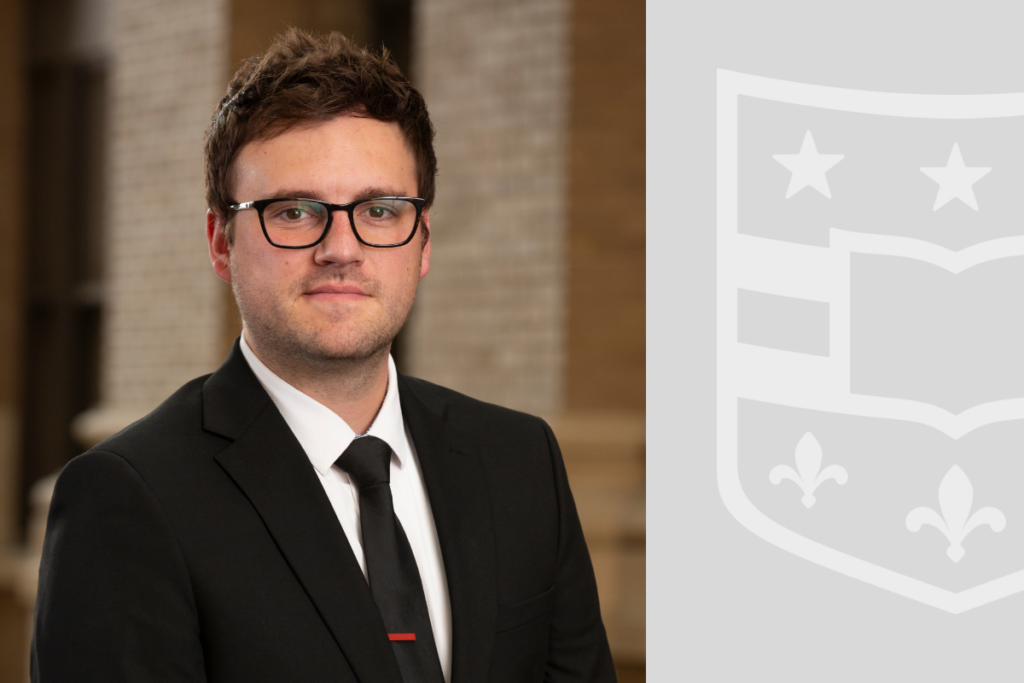
Dr. Tyler Parsons joins the Department of Medicine in the Division of Oncology as an Instructor as of May 2026.
Dr. Tyler Parsons completed his PhD at Oakland University and the Beaumont Research Institute in the Department of Radiation Oncology where he discovered that hematopoietic stem and progenitor cells (HSPCs) migrate to solid tumors after radiation therapy and differentiate into tumor-benefiting M2 macrophages. He successfully ablated this signaling mechanism both with hyper-fractionated radiation delivery and CSF-1 small molecule inhibition which resulted in decreased tumor burden and improved overall survival.
In 2021, he joined Dr. Grant Challen’s lab at WashU Medicine as a postdoctoral research fellow where he leverages clinical sample libraries and pre-clinical modeling platforms to dissect how genetic lesions in hematopoietic stem and progenitor cells shape the parallel evolution of chronic JAK2-mutant myeloproliferative neoplasms (MPNs) and secondary acute myeloid leukemia (sAML). His work in Dr. Challen’s lab has led to three first-author manuscripts which include exploring clonal hematopoiesis dynamics in patients living with HIV, the development of a novel patient-derived xenograft (PDX) model to study MPNs, and the finding that sAML clones can arise from non-MPN clones. He demonstrated that JAK2-mutant bone marrow, predominantly through TNF and IL-12 signaling, supports the expansion of independent TET2 and TP53 mutant clones and that genetic knock-out and pharmacological neutralization of these targets mitigates preleukemic clonal growth.
Dr. Parsons integrates patient-centered priorities with rigorous mechanistic studies, aiming to translate biological insight into practical tools for earlier disease detection, improved molecular surveillance, risk stratification, and rationally designed interventions that prevent or delay leukemic progression and ultimately improve patient outcomes. He has presented his work at national and international conferences and is the recipient of both a Blood Cancer United (formerly known as The Leukemia & Lymphoma Society) Fellow Award and a National Cancer Institute K99/R00 Pathway to Independence Award, which will support the establishment of his independent research program.